
Congrats to our former postdoc Ali Ünlü for this latest publication: “From prejudice to marginalization: Tracing the forms of online hate speech targeting LGBTQ+ and Muslim communities” in the Journal of New Media & Society, co-authored with Sophie Truong & myself, Tuukka Tammi (Finnish Institute for Health and Welfare (THL) and Tommi Kotonen (University of Jyväskylä), a research project funded by the Nordic Research Council for Criminology.
It’s the last of several awesome journal papers based on Ali’s postdoc work at Aalto/THL before he joined as a senior researcher at University of Virginia, and his work has had such an excellent impact in Finland.
This project explored how hate speech against Muslims and LGBTQ+ individuals spreads across platforms, how it is organized, and the role of political parties in this dynamic. This latest article delves into the narratives used against these vulnerable groups and examines how these discussions align with far-right rhetoric in Finland and across Europe. While the increasing appeal of far-right narratives globally leaves little room for optimism about inclusive language, this research provides valuable insights by analyzing developments since 2018.
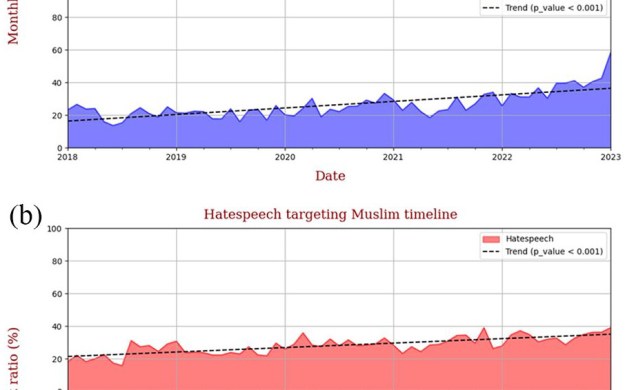
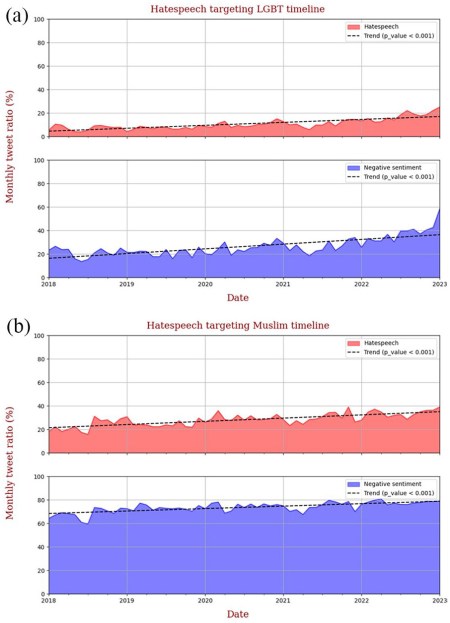
Abstract: This study investigates online hate speech in Finland, particularly Twitter messages targeting people of Muslim faith and the LGBTQ+ community, using a mixed-methods approach that combines quantitative text classification with a BERT model and qualitative thematic analysis via BERTopic and examination of highly interacted posts from 2018 to 2023. The study shows increasing instances of hate speech occurring online, primarily against Muslims, with topic modeling uncovering 32 topics for Muslims and 41 for the LGBTQ+ community, featuring themes of violence, cultural conflict, and challenges to traditional values. The LGBTQ+ community is depicted as undermining traditional norms, whereas Muslims are presented with hostility. The research underscores the necessity for digital platforms to employ nuanced strategies to counter hate speech, advocating for policies that tackle hate speech while also addressing the underlying factors and enhancing understanding of the social and cultural contexts of the targeted groups to refine detection accuracy.
Full paper available as open access here: https://journals.sagepub.com/doi/10.1177/14614448241312900
 Nitin Sawhney