
Press release by the Finnish Indian Consortia for Research and Education (FICORE) at Aalto University about our new collaborative research initiative on Living Labs in the Trust-M project, supported through a pilot grant that builds on our prior work on algorithmic literacy and digital citizenship.
Aalto University joins forces with researchers and institutions in India to pioneer innovative approaches in algorithmic literacy and digital citizenship. his project is a second phase of Critical, Playful and Inclusive Algorithmic Literacy and Digital Citizenship with a focus on leveraging Living Labs as spaces for co-creation and experimentation.
In the initial phase, the project laid the groundwork by engaging partners in Finland and India, including the INTERACT group at the University of Oulu and ARTPARK at the Indian Institute of Science (IISc) in Bangalore. Through online seminars and collaborative workshops, the team developed shared definitions and methodologies for promoting algorithmic literacy and digital citizenship in informal learning environments.
According to the principal investigators, Professor Teemu Leinonen and Professor Nitin Sawhney, “Participatory learning was an effective methodology in allowing young learners to develop their own vocabulary for articulating critical notions of algorithmic engagement and creative approaches for designing responsible concepts for AI.”
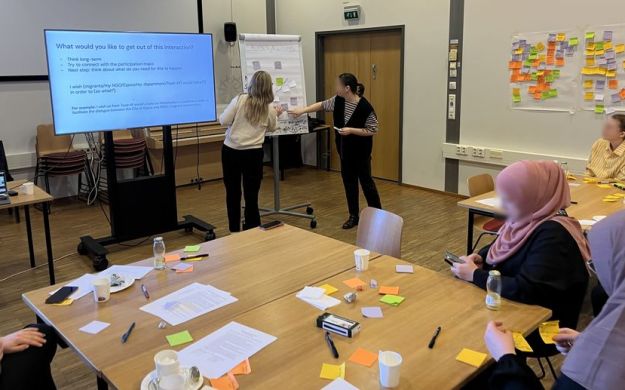
Building upon these efforts, the project now shifts its focus to Living Labs as a methodological approach to further engagement and capacity building. Living Labs are envisioned as participatory infrastructures where stakeholders collaboratively develop and test innovations through co-creation and prototyping.
Spearheading the Living Labs project are researchers Uttishta Varanasi, Rūta Šerpytytė, and Oleksandra Sushchenko from Aalto University. According to Varanasi, “A major challenge in both the Finnish and Indian contexts is accounting for increasingly diverse populations in the design of digital services. By analysing how marginalised communities participate in the City of Espoo, we hope to create generative solutions that can create more equitable and inclusive services.”
Press Release: https://ficore.aalto.fi/ficore/living-labs-to-foster-inclusive-design-of-equitable-technological-futures
The upcoming phase will see the establishment of Living Labs in the City of Espoo, expanding the target audience to include marginalized communities such as migrant women. This inclusive approach aims to involve diverse stakeholders in the development of practices for algorithmic literacy and digital citizenship, drawing upon critical global perspectives.
The pilot project is a collaboration between Aalto University Department of Computer Science and the School of Arts, Design and Architecture (ARTS).
 Nitin Sawhney